AI-generated code copyright became a front-page argument this week after developer Jakub Jankiewicz published an essay arguing that all code generated by AI should be open source. His case has two parts. Models were trained on open source code and Stack Overflow answers whose licenses require attribution, so closing their output “feels like license laundering.” And code that no human wrote should not be copyrightable in the first place. By November 16 the post had more than 1,200 points on Hacker News.
Many of the top replies went after the second point, because it undercuts the first: an open source license is a grant of rights the copyright holder owns, so code with no copyright has nothing to license. Decisions from 2026 make the line much clearer. The Supreme Court left the human-authorship rule in place in March, the Ninth Circuit ruled on Copilot output in September, and the UK proposed ending its special protection for computer-generated works. This guide walks through what those decisions protect in code generated by AI, and how QEMU and the Linux kernel decide whether to accept it.
Can AI-generated code be copyrighted in the US?
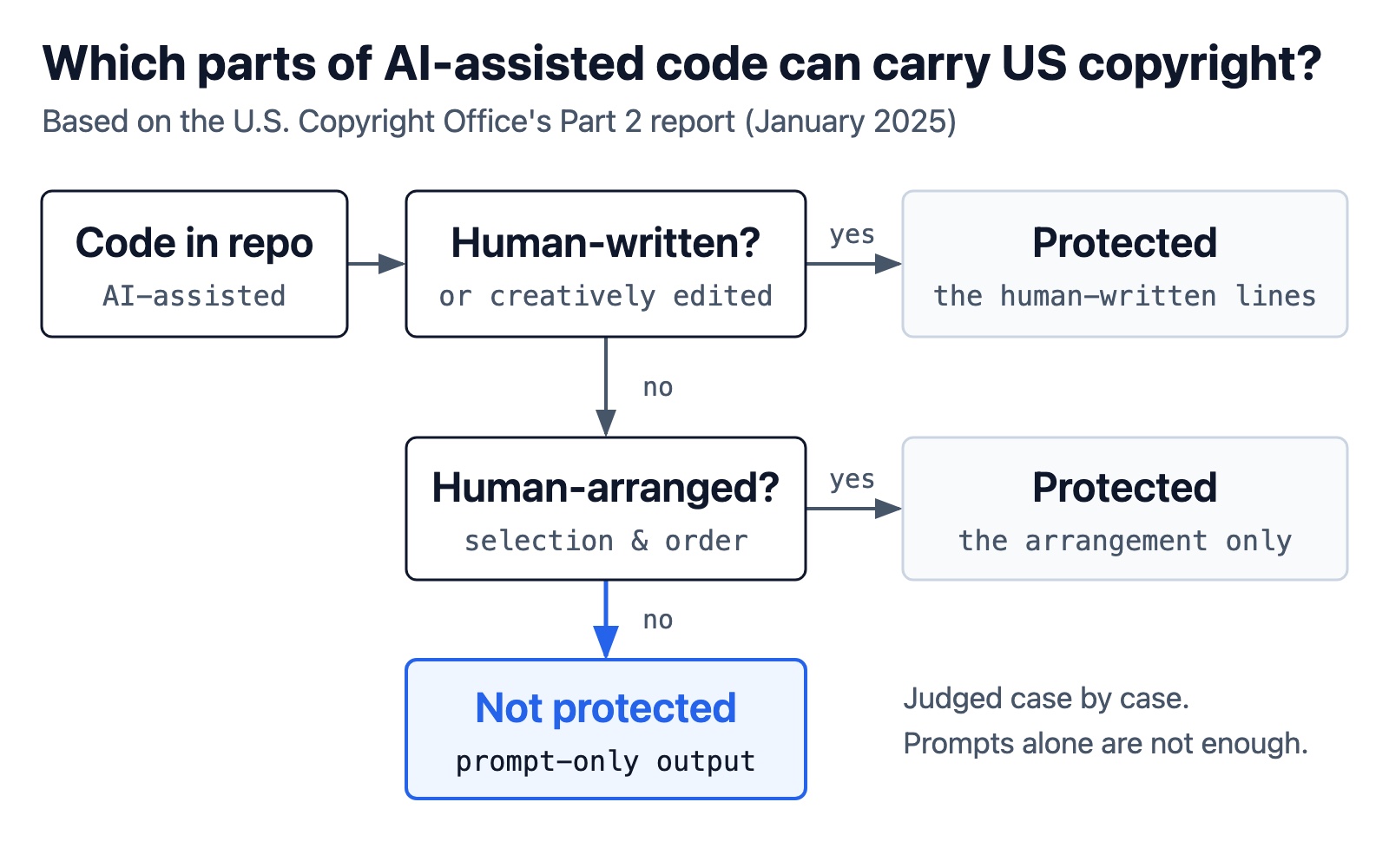
AI-generated code can be copyrighted in the US only to the extent a human authored it. The U.S. Copyright Office’s January 2025 report on copyrightability puts it in two sentences: copyright “does not extend to purely AI-generated material, or material where there is insufficient human control over the expressive elements,” and using AI “to assist rather than stand in for human creativity does not affect the availability of copyright protection for the output.”
Prompts are where most developers expect a different answer. The Office concluded that, “given current generally available technology, prompts alone do not provide sufficient human control” to make the user the author, because a prompt conveys an idea and the model decides how to express it. A detailed spec typed into an agent is still a prompt under that reading. The report leaves room for change if tools give users real control over the expressive result, and it says every case is judged on its own facts.
The courts have backed the human-author requirement. In Thaler v. Perlmutter, the D.C. Circuit held on March 18, 2025 that the Copyright Act requires a human author. Stephen Thaler’s petition asked whether output an AI system produces without a traditional authorial contribution from a person can be copyrighted. The Supreme Court denied review on March 2, 2026. A denial does not decide the merits, but it leaves the appeals court ruling standing and the Office’s practice unchanged.
Who owns AI-generated code: edits, selection and arrangement
Who owns AI-generated code depends on which parts a person contributed. The Office’s report lists three kinds of human authorship that survive inside AI output: expression a human wrote that remains perceptible in the result, creative modifications a human makes to the output, and the creative selection, coordination or arrangement of AI-generated material. Each is protected. The machine-written remainder is not.
For a codebase this splits along familiar lines. A function an engineer wrote and an agent later refactored stays the engineer’s work. A file the agent produced from a one-line instruction and nobody changed sits on the unprotected side. In between, a developer who rewrites generated code, restructures it or chooses which pieces go where may hold copyright in those changes. The Office describes in-line editing tools that let a user steer specific passages as a case where the result “should be copyrightable” if the edits meet the usual originality bar.
The Office also asks applicants who register a work containing more than a de minimis amount of AI-generated material to disclose it and describe the human contribution. Few companies register source code. Still, the same description, showing what a person wrote, changed and decided, is the record a team would want if anyone later questioned whether a module is protected.
AI-generated code copyright in the UK and EU
The UK is the main exception Jankiewicz points to, and it is moving toward the US position. Section 9(3) of the Copyright, Designs and Patents Act 1988 protects a work “generated by a computer in circumstances such that there is no human author” for 50 years from creation. The author is the person who made “the arrangements necessary for the creation of the work,” which for a general-purpose AI system is usually whoever typed the prompt.
In its March 18, 2026 report to Parliament on copyright and AI, the UK government said that, absent evidence the rule is still valuable, it proposes to remove this protection while continuing to protect works made with AI assistance. Of the online survey respondents who answered the question, 78% opposed keeping it, and OpenAI told the consultation it does “not claim copyright over generated outputs.” The removal is a proposal; section 9(3) still applies until Parliament changes the law.
The same UK report notes that EU law has no equivalent category. The EU’s originality test is tied to human creative choices, so wholly AI-generated output is unlikely to be protected there either.
If AI-generated code cannot be copyrighted, can it be open source?
Purely AI-generated code that cannot be copyrighted cannot be open source in the licensing sense either, because MIT, Apache, the GPL and CC0 all work by granting or waiving rights under copyright. With no copyright, there is nothing to grant, and the code is effectively in the public domain. That was a common reply on Hacker News: if AI code is not copyrightable, “releasing it under an open source license is meaningless,” and the essay “confuses public domain with open source.”
Jankiewicz’s proposal is closer to a norm than a legal claim. He asks developers to release AI-generated code under open source licenses or dedicate it with CC0, partly to make the result consistent across countries like the UK that do protect it, and he aims hardest at code “where humans put little effort, except writing prompts.” For that narrow slice, US law already lands close to his goal: no one holds a copyright to enforce, so anyone can reuse it. Most production code is not that slice. It mixes human-written modules, human edits and generated files, and the human parts stay protected and licensable.
His first argument, that training on open source makes the output a kind of license laundering, is about training data rather than authorship, and the replies split on it. Several commenters said programmers also learn from open source and Stack Overflow without owing their own code to the commons. One AGPL author described a company that, after receiving his violation notices, had an LLM rebuild his system; he said the clone was buggier than his code but still followed his design. Whether output like that infringes is a question for an infringement claim, which is exactly what the Ninth Circuit left open in September.
Doe v. GitHub: does Copilot output inherit open source licenses?
Under the DMCA, Copilot output counts as a new work, so leaving off the license notice of code it resembles is not unlawful removal of that notice. On September 16, 2026, the Ninth Circuit affirmed the dismissal of the DMCA claim in Doe v. GitHub, the class action programmers filed in 2022 against GitHub, Microsoft and OpenAI. The plaintiffs argued that when Copilot or Codex reproduces their code without its license text and copyright notices, the tools unlawfully remove that “copyright management information.”
The court disagreed with that framing. Copilot and Codex “do not ‘remove or alter’ copyright management information from a copy of an existing protected work but instead create new works that never contained that information,” Judge Eric Miller wrote. The opinion contrasts this with a search engine, which retrieves stored copies; if Copilot worked that way, the plaintiffs “might have a stronger claim.” The plaintiffs had standing, the court held, but no DMCA claim, and it declined to “transform run-of-the-mill copyright-infringement claims into DMCA claims,” which carry statutory damages of up to $25,000 per violation.
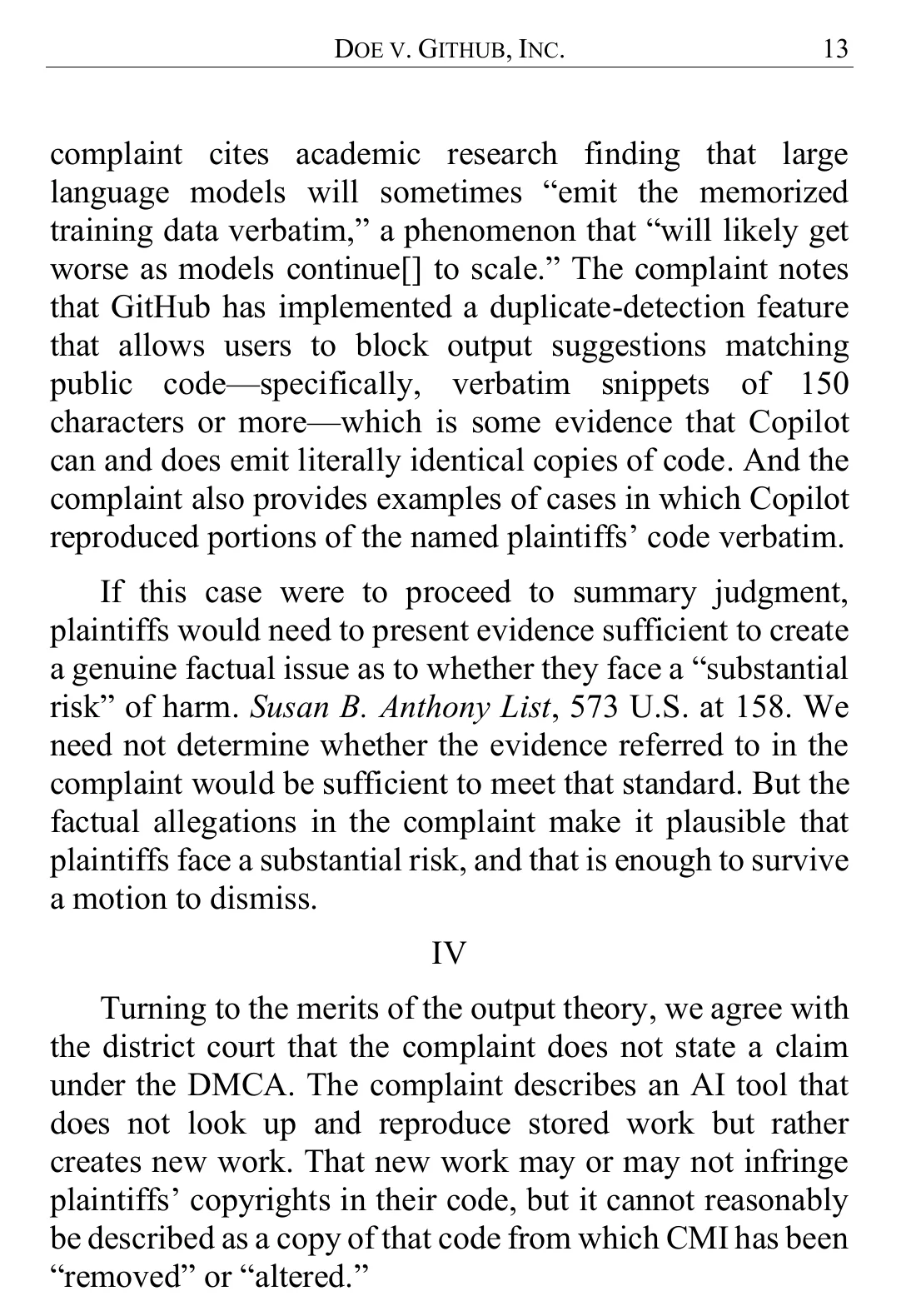
Page 13 of the Ninth Circuit’s opinion in Doe v. GitHub, Inc., No. 24-7700, filed September 16, 2026. The top paragraph describes GitHub’s 150-character duplicate-detection filter; Part IV holds that Copilot “creates new work” rather than copying stored code.
Two limits matter for developers reading this as a green light. The court expressed “no view” on whether code that is substantially similar to the plaintiffs’ would infringe their copyright, and the plaintiffs’ two breach-of-contract claims were not part of the appeal. The complaint itself described GitHub’s duplicate-detection setting, which blocks suggestions matching public code in verbatim snippets of 150 characters or more.
That setting is now optional for indemnity too. Microsoft’s Customer Copyright Commitment promises to defend paying commercial Copilot customers, including GitHub Copilot users, against third-party copyright claims over output. Microsoft’s required-mitigations page says that as of April 3, 2026, GitHub offerings have no additional required mitigations, and the duplicate-detection filter “is no longer required for CCC coverage.” Teams that want to avoid verbatim matches still have to turn it on themselves.
AI-generated code in open source projects: QEMU and Linux kernel rules
Open source projects face the reverse of Jankiewicz’s question: whether they can accept AI-generated code into a licensed codebase. Both QEMU and the Linux kernel answer through the Developer Certificate of Origin, the sign-off in which a contributor certifies they have the right to submit the patch under the project’s license.
QEMU says no. Its code-provenance policy is to “DECLINE any contributions which are believed to include or derive from AI generated content,” naming ChatGPT, Claude, Copilot and Llama, and agents built on them. The reasoning is the DCO: a contributor has to understand the copyright and license status of what they submit, and for AI output that status is “ill-defined with no generally accepted, settled legal foundation.” Using AI to research APIs, run static analysis or debug is allowed as long as its output does not end up in the patch. The project says the policy may change as the law settles.
The Linux kernel accepts AI-assisted patches with conditions. Its guidance for coding assistants says AI agents “MUST NOT add Signed-off-by tags,” because only a human can certify the DCO, and the human submitter must review all AI-generated code, check licensing and take full responsibility. A separate guideline on tool-generated content asks contributors to say which tools they used, include the prompts or a summary of them, mark which parts were affected and explain how the change was tested. Maintainers may still reject the patch or review it with extra scrutiny.
Neither project relies on whether the output is copyrightable. Their concern is provenance: whether the person signing off can vouch for where the code came from.
AI-generated code copyright checklist for teams
An AI-generated code copyright checklist comes down to six habits: record human contribution, know which files are generated, license the human-written parts, check for verbatim matches, read the vendor’s terms and follow each project’s AI policy. They apply whether the code stays proprietary, ships under a license or goes upstream.
- Keep a record of human contribution. Commit history, review comments and design notes show what people wrote, changed and decided, which is the part copyright protects in the US.
- Know which files are mostly generated. A module an agent wrote from a short instruction and nobody touched may have no copyright to license or enforce. That gets easier to miss when parallel agent threads in Claude Code Projects open pull requests on their own. If a module matters to the business, have engineers own and revise it.
- License what you can. A LICENSE file still covers the human-authored code in a mixed repository. For code you are sure no one authored, CC0 states your intent clearly, which is Jankiewicz’s own suggestion.
- Check for verbatim matches. Turn on GitHub Copilot’s duplicate-detection filter or run a similar scan if you want to avoid shipping long snippets of public code. It is no longer a condition of Microsoft’s indemnity, so it will not be on unless someone enables it.
- Read the vendor’s copyright terms. Microsoft’s commitment covers paying commercial customers; check the coverage and conditions of whichever coding tool your team uses.
- Follow the target project’s AI policy before contributing. QEMU declines AI-generated patches outright. The Linux kernel requires a human sign-off and disclosure of tools and prompts.
Agent-written projects make the split concrete. When an agent produces most of a codebase, as in how Karpathy built HackerTube with Claude Code or an agent designing a working analog synth PCB, the human contribution lies in direction, review and the changes people make. Teams already tracking what agent-written code costs per successful task can log which changes a person made in the same review step. Responsibility stays with the people who ship, too: the Lovable security exposures traced back to database rules in apps their builders generated and published.
References
- U.S. Copyright Office, Copyright and Artificial Intelligence, Part 2: Copyrightability, January 2025.
- U.S. Court of Appeals for the Ninth Circuit, Doe v. GitHub, Inc., No. 24-7700, opinion, September 16, 2026.
- UK Government (DSIT, DCMS, IPO), Report on Copyright and Artificial Intelligence, March 18, 2026.
- QEMU Project, Code provenance, developer documentation.
- Jakub T. Jankiewicz, All AI-generated code should be Open Source, 2026, with the Hacker News discussion.