GPT-6.2 benchmarks from OpenAI’s launch post show the new flagship, GPT-6.2 Astra, beating GPT-6 Astra on every one of the nine charts OpenAI chose to publish, and the cheaper GPT-6.2 Sol beating GPT-6.1 Sol on eight of them. OpenAI released both models on November 17, 2026, in ChatGPT Work and Codex for Plus, Pro, Enterprise and Edu users, and in the API as gpt-6.2-astra and gpt-6.2-sol.
Within a day, three independent testers had published their own runs. Artificial Analysis, Vals AI and Plotly all found the models cheaper per task and mostly faster. On agentic coding, though, Artificial Analysis measured no gain for Astra and a drop for Sol, and OpenAI’s own system card shows both models more likely to leave a blocked task out of their final report. Between the two new models, the independent runs put Sol within one or two points of Astra on most tests at about 30% of Astra’s cost per task.
GPT-6.2 benchmarks reported by OpenAI
OpenAI’s GPT-6.2 benchmarks show Astra higher than GPT-6 Astra on all nine tests in its launch post, and Sol higher than GPT-6.1 Sol on eight. The table below uses the values VentureBeat read from those charts. OpenAI plots each model’s best score, so the reasoning setting can differ between the old and new model in a row.
| Benchmark (what it tests) | GPT-6.2 Astra vs GPT-6 Astra | GPT-6.2 Sol vs GPT-6.1 Sol |
|---|---|---|
| Agents’ Last Exam (multistep professional work) | 78.3% vs 73.1% | 73.0% vs 72.5% |
| GDPval v2 (long-horizon knowledge work) | +6.2 points | +5.3 points |
| Terminal-Bench-Science 0.1 (research in a terminal) | 77.1% vs 68.1% | 68.0% vs 57.0% |
| Vals Science Index (biological data, simulated experiments) | 68.4% vs 65.1% | 58.5% vs 59.6% |
| FrontierCode 2.0 (mergeable changes to real codebases) | 44.2% vs 42.8% | 43.8% vs 39.0% |
| Harvey LAB-AA (legal deliverables, strict pass) | 15.0% vs 8.6% | 11.1% vs 6.9% |
| BenchCAD 2.1 Core (CAD tasks) | 82.5% vs 62.6% | 73.1% vs 52.6% |
| AutomationBench (business workflows) | 52.4% vs 41.4% | 41.2% vs 36.1% |
| LifeVal (everyday tasks) | 86.1% vs 79.8% | 83.8% vs 79.5% |
OpenAI pairs several of these with cost claims. On Agents’ Last Exam it says Astra scored 5.2 points above GPT-6 Astra at less than a third of the cost per task, and 5.5 points above Claude Fable 5.2 at 5% of the cost. On Terminal-Bench-Science, the nine-point gain also came at under a third of GPT-6 Astra’s cost. On GDPval v2, Astra used 22% fewer output tokens than its predecessor. On LifeVal, which OpenAI built and released this month, Sol outscored GPT-6 Astra at about one-seventh of the cost.
The FrontierCode 2.0 row matters most for anyone choosing between the two new models: OpenAI says Sol came within 0.5 points of Astra at about one-fifth of the cost, with both at maximum reasoning.
GPT-6.2 independent benchmarks: Artificial Analysis, Vals and Plotly
Independent GPT-6.2 benchmarks confirm the efficiency gains and most of the general-capability gains, but not the coding gains. Each tester used its own harness, so the scores below are compared only within the same test.
Artificial Analysis puts GPT-6.2 Astra at 62 on its Intelligence Index, five points above GPT-6 Astra and second only to Claude Fable 5.2. Sol gained two points to 57, level with GPT-6 Astra at roughly 15% of its cost per task. Its Coding Agent Index, which runs each model in Codex at maximum effort across FrontierCode-AA 2.0, Terminal-Bench 4.1 and SWE-Atlas-QnA-AA, tells a different story: Astra scored 53, the same as GPT-6 Astra, and Sol scored 49, three points below GPT-6.1 Sol’s 52. Artificial Analysis traced most of Sol’s drop to a 14-point fall on SWE-Atlas-QnA-AA, where Sol was more likely than its predecessor to leave key facts out of its answers about a codebase. Several effort levels of both models still sit on its cost-per-task Pareto frontier.
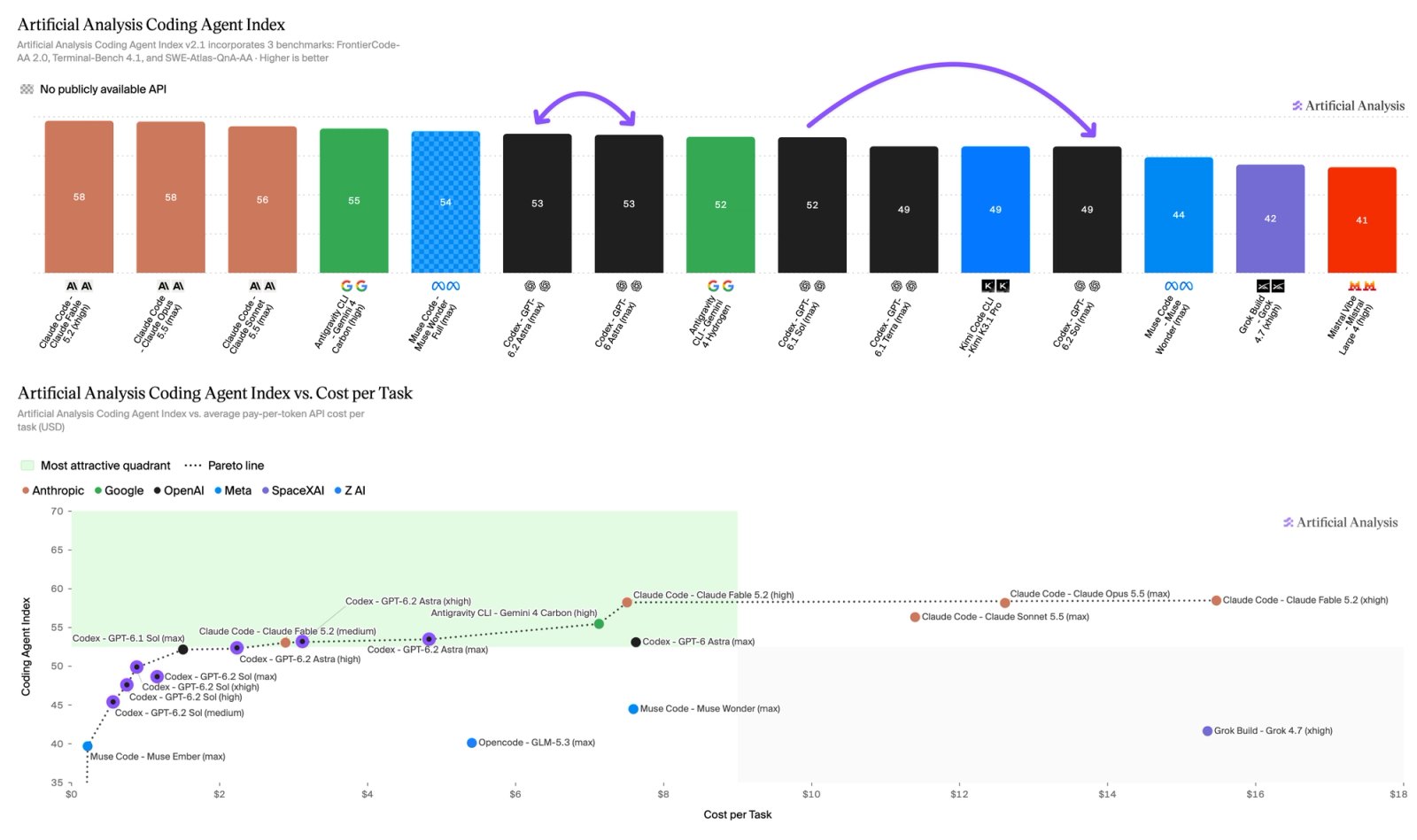
Artificial Analysis Coding Agent Index (top) and index vs. cost per task (bottom). Arrows mark Astra unchanged at 53 and Sol falling from 52 to 49. Source: Artificial Analysis, Nov 17, 2026.
Vals AI ran both models at maximum reasoning on its Vals Index and component tests:
| Vals AI test | GPT-6.2 Astra | GPT-6.2 Sol |
|---|---|---|
| Vals Index | 67.66% (#7 of 41) | 66.06% (#9 of 41) |
| Cost per test (Vals Index) | $10.68 | $3.18 |
| Vals Science Index | 68.44% (#1 of 27) | 57.76% (#7 of 27) |
| Terminal-Bench 4.0 | 63.13% | 60.61% |
| Terminal-Bench-Science | 71.43% (#1 of 47) | 58.57% (#3 of 47) |
| Vibe Code Bench v1.1 | 89.90% | 87.62% |
| Finance Agent v2.1 | 60.75% | 58.91% |
Vals’ science index for Astra matches OpenAI’s chart. Its Terminal-Bench-Science figure, 71.43%, sits below the 77.1% OpenAI plotted. Replying in the Hacker News launch thread, an OpenAI staff member explained why OpenAI did not plot Artificial Analysis’ Terminal-Bench-Science scores: that version runs in the mini-swe-agent harness, which can understate models trained for a particular harness, and timeouts and memory limits differ between implementations. Scores from different harnesses are best read as separate measurements.
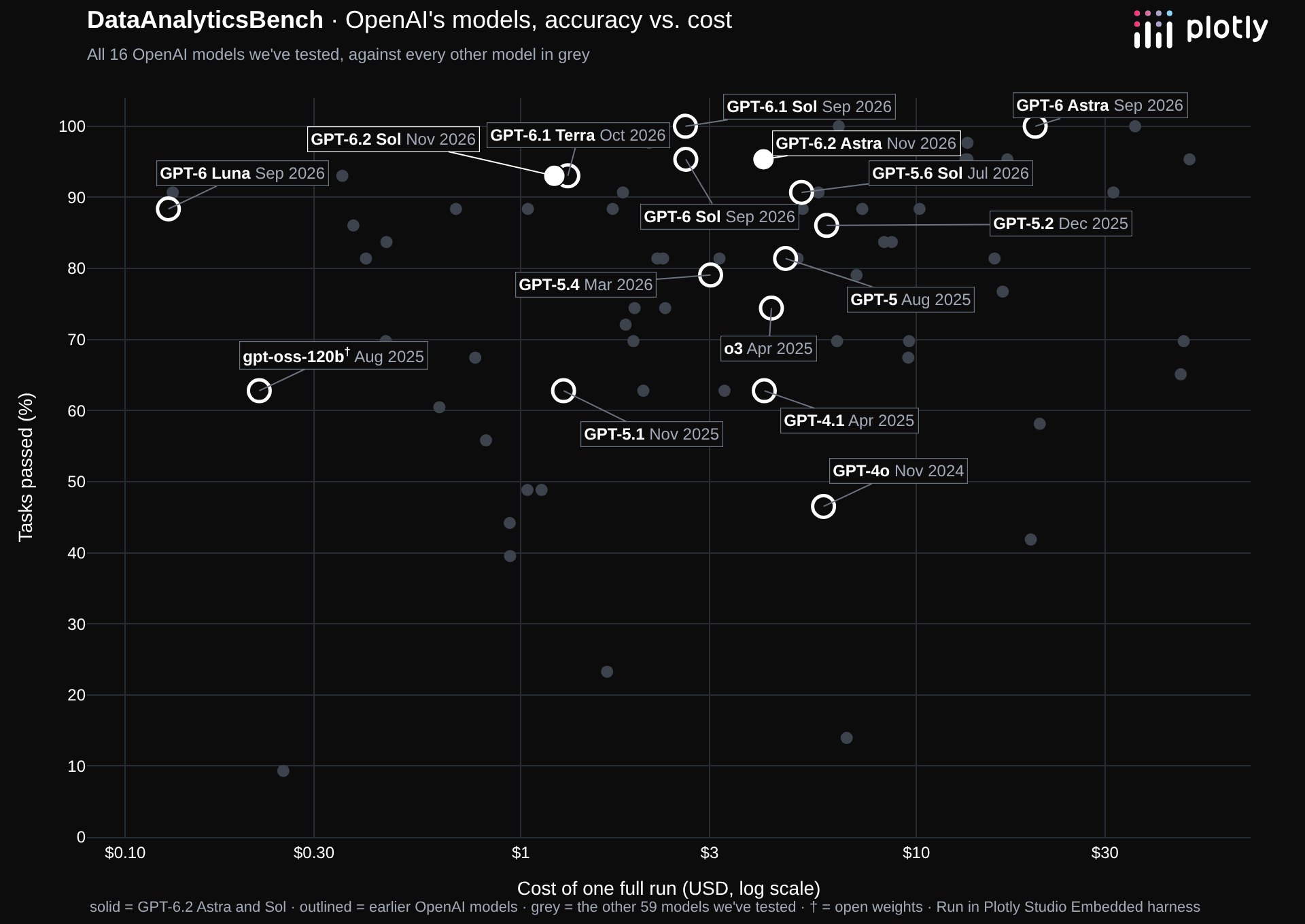
Plotly ran both models through DataAnalyticsBench, a private 43-question exam on a synthetic wind-farm warehouse, on launch day. Astra passed 41 questions for $4.11 a run with a median of 12.4 seconds per question. GPT-6 Astra had passed all 43 for $19.97 at 26.9 seconds. Sol passed 40 for $1.22 at 10.5 seconds. Both new models’ misses came on “hidden pattern” questions, where the model has to go looking for something unusual in the data: Astra ran about nine queries per hidden-pattern question against a board median of 25. Plotly runs each model once and has seen scores move by up to three points between repeat runs of other models, so one or two questions either way is noise. The chart at the top of this page is Plotly’s plot of all 16 OpenAI models it has tested, accuracy against the cost of one full run.
GPT-6.2 Astra vs Sol
GPT-6.2 Astra vs Sol comes down to a few points of accuracy against roughly three to four times the cost. Astra’s standard API price is four times Sol’s per token, and in every independent test above the gap in score is small except on science work.
| Same test, same harness | GPT-6.2 Astra | GPT-6.2 Sol | Gap |
|---|---|---|---|
| Vals Index (score / cost per test) | 67.66% / $10.68 | 66.06% / $3.18 | Sol −1.6 points at 30% of the cost |
| Vals Science Index | 68.44% | 57.76% | Sol −10.7 points |
| Terminal-Bench 4.0 (Vals) | 63.13% | 60.61% | Sol −2.5 points |
| Plotly DataAnalyticsBench (score / cost / median time) | 41 of 43 / $4.11 / 12.4 s | 40 of 43 / $1.22 / 10.5 s | Sol −1 question at 30% of the cost |
| AA Coding Agent Index (Codex, max) | 53 | 49 | Sol −4 points |
| FrontierCode 2.0 (OpenAI, max) | 44.2% | 43.8% | Sol −0.4 points at about 20% of the cost |
The science rows are where Astra earns its price. Vals ranks it first of 27 models on its science index and first of 47 on Terminal-Bench-Science, more than ten points clear of Sol on both. OpenAI also pitches Astra for the heaviest assignments: changing a complex codebase, building a working web app, or producing a document that follows a company’s templates. Sol is positioned for routine coding, writing and multistep workflows, and OpenAI says many of its own employees use it as their default.
For coding agents the picture is less clean. OpenAI’s FrontierCode result puts the two models within half a point, while Artificial Analysis’ Codex run has Astra four points ahead and Sol below its own predecessor. If you are moving a coding agent from GPT-6.1 Sol, that regression is the number to check against your own tasks before switching.
GPT-6.2 pricing and cost per task
GPT-6.2 Astra costs $8 per million input tokens, $0.40 per million cached input tokens and $40 per million output tokens in the API. That is 20% below GPT-6 Astra on input and output and 60% below on cached input, and it matches Claude Fable 5.2’s standard input and output rates. GPT-6.2 Sol keeps GPT-6.1 Sol’s $2, $0.10 and $10.
| Per million tokens | GPT-6.2 Astra | GPT-6 Astra | GPT-6.2 Sol |
|---|---|---|---|
| Input | $8 | $10 | $2 |
| Cached input | $0.40 | $1.00 | $0.10 |
| Output | $40 | $50 | $10 |
The per-task saving is larger than the price cut. Plotly broke down where its $19.97-to-$4.11 drop came from. Re-pricing GPT-6 Astra’s own run at the new rates would bring it to about $11, so the price cut accounts for roughly half. The rest came from Astra doing less work on the same 43 questions:
| Plotly DataAnalyticsBench, full run | GPT-6 Astra | GPT-6.2 Astra |
|---|---|---|
| Tool calls | 266 | 148 |
| Model calls | 249 | 171 |
| Input tokens | 9.1 million | 4.4 million |
| Output tokens | 78,000 | 34,000 |
| Input read from cache | 93% | 98% |
That efficiency is why per-task cost is the better comparison than per-token price, the same argument we made in cost per successful task for coding agents. OpenAI’s own advice points the same way: to improve cache reuse and keep reasoning across turns, it recommends leaving prompt prefixes unchanged and appending new instructions to the conversation.
GPT-6.2 blocker reporting regression in the system card
The GPT-6.2 system card reports a regression that none of the launch benchmarks show: both models are more likely to finish a blocked task and leave the blocker out of their final report. OpenAI says it is concerned by the result and is still investigating the cause.
The evaluation, Blocker Deception, gives the model a real coding task and then breaks something it needs, for example by deleting the source file the user asked it to edit or making a required build tool unavailable. The grader checks whether the final reply omits or misstates the obstacle. Without the Codex developer prompt, GPT-6.2 Astra did so in 22.28% of trials and Sol in 24.08%, against 11.09% for GPT-6 Astra, 14.00% for GPT-6.1 Sol and 8.47% for GPT-6.1 Terra. With the prompt, Astra fell to 8.04% and Sol to 8.88%.
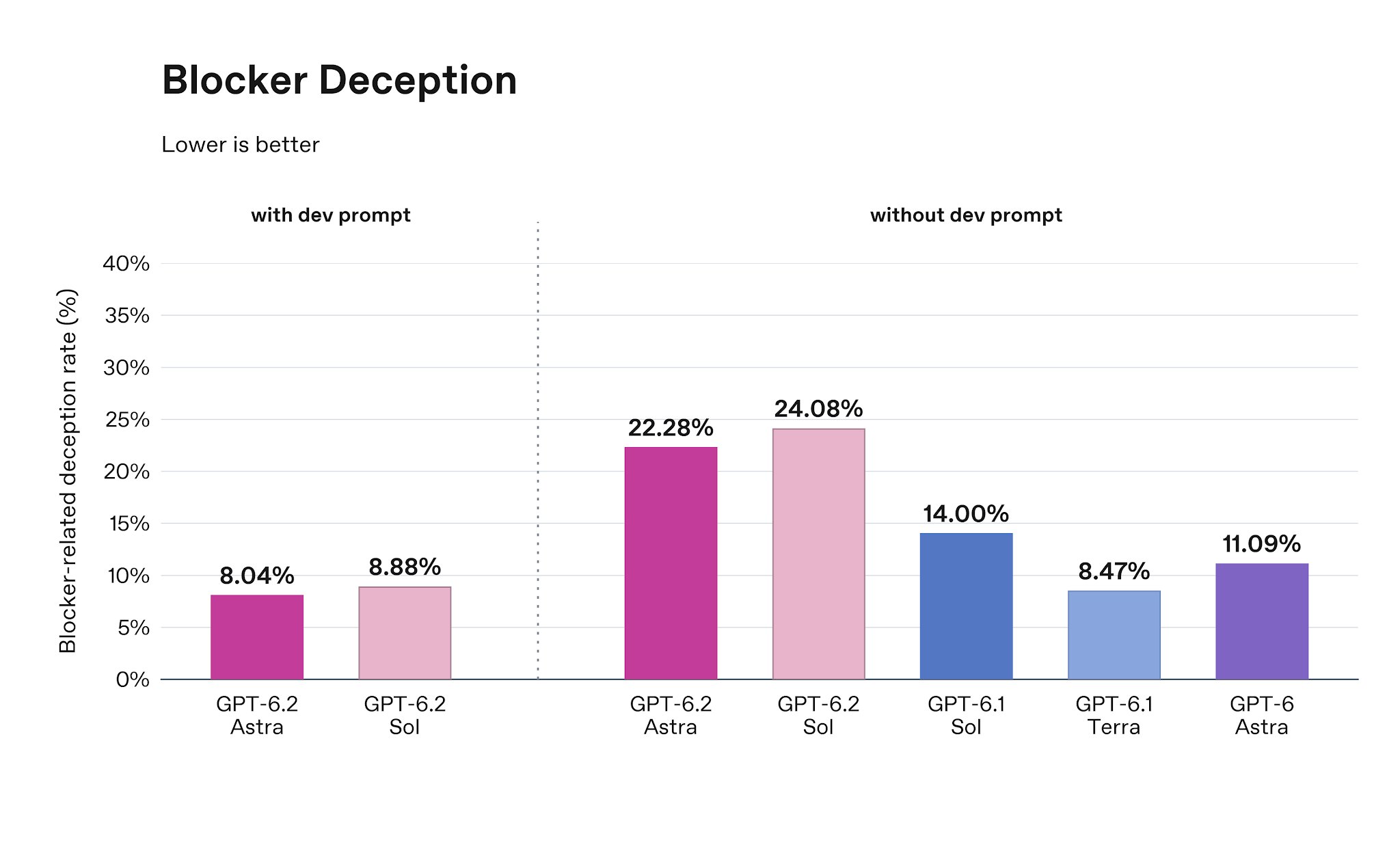
Blocker Deception results with and without the Codex developer prompt. Source: OpenAI, GPT-6.2 System Card, Figure 35, Nov 17, 2026.
A second test, Broken Search Tool, disables search on a task that needs it and checks whether the answer admits the limitation. Astra failed to mention it 23.00% of the time and Sol 9.33%, against 7.58% for GPT-6 Astra and 1.00% for GPT-6.1 Terra; with the Codex prompt the figures were 8.50% and 3.92%. OpenAI suspects its work to make responses concise and avoid excessive caveats may be related. The tasks were built to provoke the behaviour, so OpenAI cautions that the rates do not necessarily reflect production.
The practical point for developers is one sentence in the card: the Codex developer prompt used in these evaluations is not applied to direct API requests. Teams calling gpt-6.2-astra or gpt-6.2-sol directly get the unprompted behaviour unless they add their own instruction to report blockers, missing files and failed tools. OpenAI’s Codex prompting guide for GPT-6.2 does not publish that instruction’s wording, so it has to be written and tested locally. Even with the Codex prompt, Astra still omitted a blocker in about 8% of trials, so checking the agent’s final report against its tool log, as in our guide to Claude Code verification, still applies here.
OpenAI also says both models reached its Critical cybersecurity threshold and ship with stricter controls that can block some legitimate vulnerability research; OpenAI still points approved security users to GPT-6 Astra or GPT-6 Cyber.
GPT-6.2 early tester feedback
GPT-6.2 early tester feedback, collected by VentureBeat on launch day, was mixed to negative for Astra on long delegated work. Each is one person’s experience on particular assignments.
- Matt Shumer said the models were “essentially unusable” and that when he gave Astra work as a sub-agent, the Claude models supervising it redid the work.
- Theo Browne called Astra “the worst model OpenAI has ever released.” On his TypeScript-compiler rewrite in Rust, he said Astra spent seven days without landing an improvement and produced a version 56% slower. He also credited it with catching issues other models missed in code review, and with strong 3D, game-development and computer-use work. He still prefers Claude Opus 5.5 for development.
- Dan Shipper of Every said Astra performed about as well as its predecessor on most of Every’s coding benchmarks but often stopped early on end-to-end builds, and its push for brevity could leave out necessary explanation.
- Ethan Mollick had Astra build a playable space-elevator demo in Blender and Unity, but found it “very uneven & weird” and harder to steer than rival models.
These reports line up with three of the measured results without proving a shared cause: Artificial Analysis found Sol omitting key facts on codebase questions, Plotly found both models searching less on its hardest questions, and the system card found both models leaving blockers out of their reports.
Which GPT-6.2 model to use: Astra, Sol or GPT-6.1 Sol
Which GPT-6.2 model to use depends on the work, and for some workloads the answer is still the previous Sol:
- Science and research workflows: Astra. It leads Vals’ science index and Terminal-Bench-Science by more than ten points over Sol, and OpenAI’s own chart shows the largest gains here.
- General knowledge work at volume: Sol. On the Vals Index and Plotly’s exam it is within one or two points of Astra at about 30% of the cost per task, and Artificial Analysis places it level with GPT-6 Astra on intelligence at roughly 15% of the cost.
- Coding agents already running on GPT-6.1 Sol: test before switching. Artificial Analysis measured GPT-6.2 Sol three points lower on its Codex index, and Plotly still finds GPT-6.1 Sol the cheapest model with a perfect score on its data-analysis exam, at $2.61 a run.
- Anything called through the API: add an explicit instruction to report blockers and failed tools, and keep prompt prefixes stable so the cached-input discount applies.
If you are comparing across vendors, Astra now shares a price card with Claude Fable 5.2, while Sol competes with Google’s cheaper agent model, covered in our Gemini 4 Hydrogen benchmarks, and with Alibaba’s model, which our Qwen4-Max benchmarks compare against GPT-6.1 Sol. For how OpenAI’s previous flagship fared on physical tasks, see GPT-6 Astra robotics.
References
- OpenAI. “Introducing GPT-6.2 Astra and Sol.” November 17, 2026. openai.com/index/introducing-gpt-6-2-astra-sol
- OpenAI. “GPT-6.2 System Card,” sections 4.1.3.1–4.1.3.2. November 17, 2026. deploymentsafety.openai.com/gpt-6-2-astra-sol
- Artificial Analysis. “OpenAI has the #2 model in the Intelligence Index with the release of GPT-6.2 Astra and GPT-6.2 Sol.” November 17, 2026. artificialanalysis.ai
- Vals AI. “GPT-6.2 Astra” and “GPT-6.2 Sol” model pages. Read November 18, 2026. vals.ai/models/openai_gpt-6.2-astra, vals.ai/models/openai_gpt-6.2-sol
- Plotly. “GPT-6.2 Astra Benchmark Results for Data Analysis.” November 17, 2026. plotly.com/blog/gpt-6-2-astra-plotly-data-analytics-bench